Before we get started, let me point you to the post I wrote for They Boldly Went back at the fifty year mark. It’s broader and probably better than what we’ve got here, but hey, you decide.
“Arena”
That was the first episode I saw. It was 1981, I was seven years old, and I had a fish bone stuck in my throat. This kind of mishap was not uncommon for a kid in the South at the time — at least four meals a month came from the local lakes — and I was stuck sitting on the floor of my parents’ bedroom, watching their TV and sipping vinegar to make the errant piece of calcium phosphate and collagen bend and move one way or the other. 1 This bit of folk medicine has since been disproven, but it was Arkansas in the Eighties, which was basically the rest of the world in the Thirties.
“Arena” hit me like a ton of bricks. It was colorful, it was fast,2Seriously, today’s kids have no idea just how glacial the pacing was on most TV in the Olden Times. it was grown-up without being out of my reach, and in a moment that was positively galvanizing, it ended with a moment of compassion instead of the Gorn captain being killed by our hero.
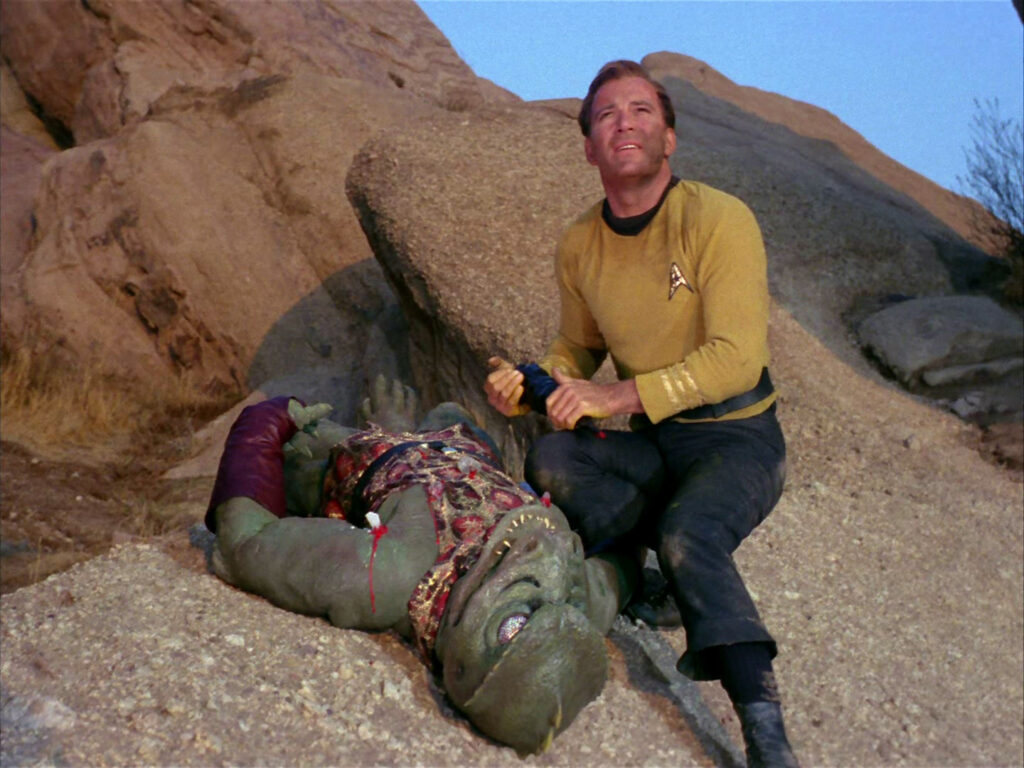
This blew my mind.
They actually solved the problem with their brains instead of just doing what they were supposed to do. I rushed downstairs to tell my parents what I’d seen — they were watching something like Dynasty or Eight is Enough or The Harlem Globetrotters on Gilligan’s Island — and my dad simply responded with “So, you swallowed the fish bone?”
From that point on, I’d hoard my folk’s TV every Saturday and check in with crew of the Enterprise while they got some much-needed peace and quiet.
What Star Trek Taught Me
Yet, I know you can go get Jean-Luc Picard’s Guide To Upper Management or whatever, but let’s make this about me and the original Star Trek, okay? I learned a lot of lessons from Kirk and crew, things I still hold close some 40+ years later.
Infinite Diversity in Infinite Combinations
It’s obvious now, but for a kid who was growing up in the south in the non-anodyne version of the Eighties that existed in the real world and not Stranger Things, it was incredibly important for me, a shitheaded white kid, to see a Black woman, a Japanese man, and yes, a goofy Russian portrayed as actual professionals, people who had done the same work as anyone else to get where they were and who were trusted by their peers who looked more like me and the people I was growing up around. The show was created during the height of the Cold War and it successfully argued that a mix of cultures, a diversity of viewpoints, an array of backgrounds was necessary to reach a better future and it maintained that relevancy for the rest of the 20th century.
Even when The Original Series was ham-handed with things like “Let That Be Your Last Battlefield”3All respect to Frank Gorshin in this one. What a powerhouse! and the kiss in “Plato’s Stepchildren,” it was still doing more than any other TV show to help me be a better person. “The Devil In The Dark,” among the best first watches a viewer can have, features a misunderstood alien creature who’s killing miners in an isolated facility with a revelation that reminds the audience that just because it’s not shaped like a human, that doesn’t mean it’s not a person.
The Needs of the Many Outweigh the Needs of the Few
Spock says this in Star Trek II and it may have done more to make me pinko leftist I am now than any number of stump speeches and political texts. It’s a simple statement that says so much. Outside of the obvious connection to the movie in which it appeared, it’s also a statement that helped allow the Federation as it appears in the series to even exists. Those that are selfish — Harry Mudd, Cyrano Jones4Both of whom are charming as fuck, to be sure. — are shown as criminals and scoundrels, people who are using the largesse of the society as a whole to benefit themselves.
Star Trek isn’t communist. There’s still trade, there’s still shops and markets and bars and private businesses, but most of the big problems were settled by the 23rd century by a socialist society who knew that it was better to lift up everyone instead of letting a few hoard everything. The Next Generation made this more explicit, but the implications of a massive fleet of faster-than-light ships with civilian colonies and cultural relations among hundreds of worlds are obvious. You don’t get that by being Elon Musk or Jeff Bezos.
Risk is Our Business
Surprising no one, I was an absolute maniac for NASA when I was a kid. My dad was an engineer, so he loved the technical stuff, my mom liked going to Florida for the beaches, so we made multiple pilgrimages to Cape Kennedy. There’s no place on the planet that better represented this philosophy, brilliantly brought to life by William Shatner in “All Our Yesterdays.” To this day, this phrase comes to mind whenever I think about the men who died on the pad in Apollo 1, the Challenger’s diverse crew (two women, a Japanese man, and a Black man and three white men), and those who left us when Columbia disintegrated during reentry (again, diverse, with an Indian woman, an American woman, an Israeli scientist and a Black man.) They knew what the risks were but they did the job anyway.
We don’t get to do big things without taking big risks. The society we see in Star Trek occurs because of big risks. Because someone swallowed their fear, trusted their instincts and their support system, and took a swing. It’s something we should embrace when we get the opportunity, not shirk away. I’m living with the woman I love, in a state I love, far from what I’d known for the previous 20 years because I took that risk, and I was lucky enough to meet her in the first place because of a risk I took in 1998.
Logic is the Beginning of Wisdom
The heart of the original series is Kirk, Spock, and McCoy. Spock’s the brains, as you know, but it’s the synthesis of what he, McCoy, and Kirk are that really makes the entire enterprise5pun intended work. On their own, they’re incomplete. Spock is a brilliant scientist because of his devotion to reason and careful control of his human side.6We later learn how much of his core character was because of that human side; after he fucked off to Vulcan to embrace Kolinahr to purge himself of emotions entirely, he was essentially unrecognizable when came back to the Enterprise. Meanwhile, McCoy is a great doctor, a man who’s likely as smart as Spock, but he’s too human in many ways. He’s irascible, suspicious of technology, a man who trusts his gut more than anything else.7He’s also my favorite character in fiction because of this. Kirk takes responsibility, makes judgements, and uses their input to make decisions that affect the ship and crew.
You can’t math everything; you can’t feel your way through everything. You have to combine logic with your own moral and ethical framework to make decisions. This may be the most important thing that Star Trek taught me (and hopefully the rest of the audience.)
Why Star Trek Will Always Matter To Me
We’ve had a dozen sequel series and 13 theatrical features since Star Trek went off the air. It’s been updated, remixed, repackaged, parodied, tributed, and scrutinized for good and ill. With the Ellison takeover of Paramount, it’s about to go back on ice. It’s happened before; it’ll probably happen again. Star Trek is going to live on. It’s always going to be streaming somewhere, and as someone with a too-large physical media collection, I can confidently state that I’ll be popping in a disc from time to time.
Star Trek has so much hope to offer us. It shows us a better world, where we are better people, where our fears of hunger and poverty and of losing our right to self-determination and self-expression are vanquished. Yes, it’s all packaged in an episodic science fiction series, but what the future that it represents means so much to so many.
Star Trek is always going to have an audience because people are always going to want to hear that they matter, that they and their tribe, be they Black, trans, Asian, Latino, queer, intersex, nonbinary, asexual, bisexual or even spectacularly boring white cis guys who write way too much about science fiction shows from the 1960s are going to make it.
Go Boldly. Be Kind.

Leave a Reply